A curated collection by Ultra-Normal LLC
Build bridges. Arrange stones. Grow trees toward light. Tell stories with your kids. Play that makes something beautiful.
The Collection
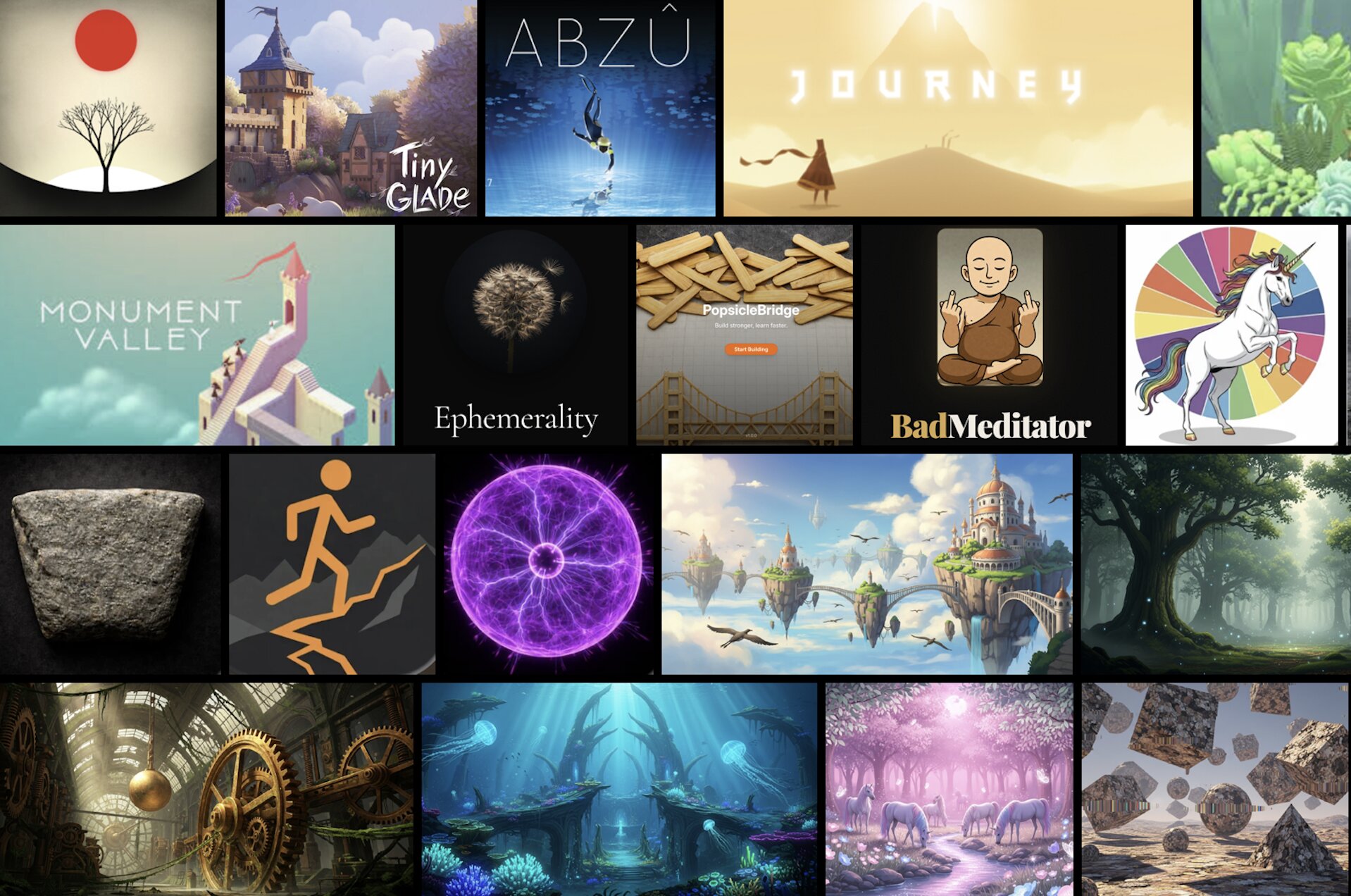
Our zen games and the mindful indie games we love. Built to tinker with, not to grind through.
Joel McDonald
Grow a tree toward light. The best contemplative game ever made and the reason this site exists. A zen tending game about growth, loss, and the satisfaction of making something beautiful. Like Prune? You'll love this whole collection.
thatgamecompany
A spiritual odyssey with wordless multiplayer. The meditative indie game that proved contemplative play could reach millions of players. Still unmatched for emotional impact without a single word.
Pounce Light
Free-form diorama builder with no goals, no timers, no wrong answers. A mindful building game with grid-less construction and pure creative freedom. The zen of making without purpose.
Ultra-Normal LLC
Seven zen games for people who tried meditation and hated it. Stack rocks, rake sand, stir matcha, pop thought bubbles. The best calm game for restless minds... no ads, no subscriptions, no breathing exercises.
Ultra-Normal LLC
Arrange stones, leaves, shells into mandalas and cairns. A contemplative art game inspired by Andy Goldsworthy. Slide the light from dawn to dusk, then watch your creation dissolve back into nature. One of the best relaxing mobile games about nature without ads or competition.
Ultra-Normal LLC
The mindful building game for the classic STEM bridge project. Design with real physics, test under load, watch stress propagate and learn exactly why your bridge failed. A tinkering game for builders who want to iterate like an engineer.
ustwo games
Impossible architecture in stunning color. Simple enough to calm, complex enough to engross. A contemplative puzzle game and a masterwork of meditative indie design without competition.
Giant Squid Studios
Underwater exploration from the creators of Journey. A meditative game about the ocean where you can sit on the seabed in contemplative silence. No competition, no time limits. Just depth.
thatgamecompany
Control the wind. Carry petals across fields. A wordless poem about nature and movement without purpose. One of the original meditative games... still one of the best relaxing games without ads.
Ultra-Normal LLC
An ultramarathon indignity simulator set on the Pemi Loop. Strategy game about suffering, type 2 fun, and the hilarious betrayal of your own body. Oregon Trail meets ultrarunning. Under 10 minutes. Free.
Ultra-Normal LLC
Collaborative storytelling that transforms the phone into a campfire. Voice-first, so a four-year-old becomes co-author. Relaxing family games without ads, data collection, or AI doing the work for you.
Ultra-Normal LLC
Perceptual training that treats your senses like muscles. Daily drills, 30 seconds, immediate feedback. Not a mindfulness game... this is HIIT for your senses. Turn your volume up to 11.
Ice Water Games
Care for succulents in real time. No clock, no leaderboard, no pressure. A slow tending game about the satisfaction of patient growth. Relaxing mobile game without ads or goals.
Oskar Stålberg
Place colorful buildings above the sea. No tasks, no grinding. A zen building game where imagination is the only limit. One of the best contemplative games without competition or objectives.
Ultra-Normal LLC
Genuine encounters with specific natural entities. Every session focuses on a real, specific thing... never generic ambience. Worldfulness, not mindfulness. A meditative game about nature that asks you to notice, not consume. For people who want contemplative play grounded in the actual world.
Ultra-Normal LLC
A private sanctuary for noticing what makes you feel alive. Not social media, not gamified gratitude. Capture fleeting moments before they fade. A contemplative app about impermanence and attention for mindful people who want something quieter than a feed.
Ultra-Normal LLC
A white 3D cube floats in black space, rotating to reveal breathing instructions. Minimal Viable Design as philosophy. The most stripped-down zen meditation game you'll ever find. No ads, no tracking, no guided voice.
If you make a contemplative game and want it considered for the collection, write to us at hello@contemplativegames.com.
Daily Rituals
Play isn't only hands-on. It's what happens when an idea hits you sideways and your brain lights up for no productive reason. These apps treat curiosity as a daily practice — one idea, one quote, one encounter at a time. No infinite scroll. No binge. Desire acknowledged, then restrained.
Ultra-Normal LLC
One strange, rigorous, sometimes unsettling idea per day. Then we tell you no. It doesn't pretend to be a vitamin — it admits it's candy. The same machinery that can hollow out a life can build one. This is that machinery, pointed somewhere good.
Ultra-Normal LLC
A daily idea engine that treats your craving for novelty as a feature, not a bug. Curated provocations from philosophy, science, history, and the weird edges of human knowledge. Get hooked on something worth being hooked on.
Ultra-Normal LLC
Microlearning that doesn't insult your intelligence. Great quotes, real sources, zero gamification. The point isn't to collect — it's to sit with a sentence long enough for it to change how you see the next hour of your life.
Ultra-Normal LLC
One paradox per day. Limited time. No undo. The app that recreates the conditions under which philosophy has always mattered: uncertainty, constraint, consequence. Open the box. Collapse the wavefunction. Live with what you chose.
Ideas are hot. Let's play.
Essay
Apple has no category for contemplative play. That's not a design oversight... it's a cultural confession.
Open the App Store. Select Games. You'll find Adventure, Board, Card, Casino, Indie, Puzzle, Racing, Role-Playing, Simulation, Sports, Strategy.
What you won't find: a category for creative play. Nothing for contemplative games. No home for experiences where the point isn't winning, competing, or solving. According to Apple's taxonomy, if you're not racing toward an objective or shooting something, you're not playing.
This isn't just a design oversight. It's a cultural confession. We've split the world into productivity and entertainment, optimization and distraction. There is no third category... no slot for the slow work of shaping growth toward light, for making something beautiful and releasing it, for the kind of play that teaches you who you are by refusing to tell you whether you won.
Johan Huizinga saw this coming. In Homo Ludens (1938), he argued that play isn't marginal... it's the generative force of civilization. His late-career worry was prescient: he saw the play element "on the wane," threatened by efficiency and routinization. He hadn't yet imagined gamification.
The best game I've ever played is Prune. You grow a tree. You trim branches. Light streams in and your tree reaches toward it, or doesn't and branches die. No score multipliers. No achievements. Just the quiet work of shaping growth toward light.
Prune sits in the Puzzle category because there's nowhere else for it. The system has no language for what it actually is: a game about tending, about loss, about the satisfaction of making something beautiful.
Roger Caillois gave us a taxonomy of play in Man, Play, and Games (1961): competition, chance, simulation, vertigo. But he also distinguished between paidia... free, spontaneous play... and ludus... structured gaming. Contemporary gaming has collapsed play into competition plus structure. What's missing from the App Store: any category for paidia without competition.
D.W. Winnicott went further. In Playing and Reality, he argued that play is how human beings become real. His concept of transitional space... the intermediate area between inner and external reality... is where creativity originates. Most people, he argued, experience enough creativity to know they are "mostly living uncreatively, as if caught up in the creativity of someone else, or of a machine."
Caught up in the creativity of a machine. Written in 1971. He could be describing your Instagram feed.
Most creativity apps optimize for control and permanence. Most mindfulness apps reduce nature to passive imagery. Contemplative games occupy the gap between making and receiving. You work with materials that have weight and fragility. You compose for changing light. And if you choose, you let it go. That's the heart of LandArt Studio: arrange stones and leaves into something beautiful, then watch the tide dissolve it.
C. Thi Nguyen, whose Games: Agency as Art won the APA Book Prize, argues that games are a "library of agencies." His warning: gamification is value capture... simplified game values colonizing our real-world value systems.
This site is a home for the agencies the industry forgot to stock. Build a bridge and watch the physics break it in PopsicleBridge. Stack rocks in BadMeditator. Tell a story with your kid in PassTheStory. If you've ever arranged stones on a beach or stayed up late building something just because the building itself felt like magic... you're already one of us. You just didn't have a name for it.
By Justin Neuman / Ultra-Normal LLC

All playing is a being-played.
— Hans-Georg Gadamer
Founder Stories
The origin stories behind our games. Personal, specific, and not written by AI.
PopsicleBridge
In middle school, I learned how to game the system. My dad recommended wrapping the entire structure in transparent packing tape...
PassTheStory
On long car rides and hiking mountain trails, my family would tell stories together. But we'd always lose the thread...
Trail Torment
If you're in the ultra-running world, you probably know the Pemigewasset Loop. It might be haunting your nightmares...
Sensorium
Modern life is a sensory deprivation experiment we never volunteered for. Screens flatten depth...
BrainSmut
Most educational products lie about human behavior. They pretend learning is medicine. BrainSmut admits it's candy...
Schrödinger's Box
We live inside devices optimized to remove friction. Nothing demands commitment. Schrödinger's Box is a refusal of that environment...
A PopsicleBridge founder's story
In middle school, I learned how to game the system.
The assignment: build a bridge from popsicle sticks, tape, and wood glue. Span 18 inches. Hold as much weight as possible.
So after building a decent truss bridge, my dad (an engineer) recommended that I wrap the entire structure in transparent packing tape. Every joint. Every beam. Binding the whole thing into a composite shell that looked like a normal bridge but performed like something else entirely.
I can't remember how much weight that bridge held, but I do remember that it was so good and so strong that my teacher disqualified me in a fury.
Thirty years later, I still think about that bridge. It was one of the few times school felt like play. Not memorizing formulas. Not following steps. Building, breaking, revising. Thinking.
The popsicle-stick bridge might be the best STEM project ever invented. Millions of students build them every year. But there's never been a serious digital tool for it... until I built one.
Justin Neuman / Ultra-Normal LLC
Turning the phone into a campfire
On long car rides and hiking mountain trails, my family would tell stories together... one sentence each, back and forth. They chronicled the "Saga of the Soggy Socks." But we'd always lose the thread.
Because it's voice-first, a four-year-old who can't yet type becomes a full co-author. Every story lives entirely on your device. No ads. No cloud. No AI doing the storytelling for you.
PassTheStory turns the device into what the campfire used to be: not a portal to somewhere else, but a place where you meet each other.
Justin Neuman / Ultra-Normal LLC
The ultra-marathon simulation game
If you're in the ultra-running or backpacking worlds, you probably know the Pemigewasset Loop. 32 miles. 10,000 feet of elevation. Most people do it in two or three days.
You're the pacer. Roll a random starting condition. Pack ruthlessly. Coach your runner through 32 miles of chaos. Over 600,000 people now complete ultramarathons every year. It's amazing, absurd, hilarious, and disgusting. Trail Torment captures the part no other game does.
Free. Under ten minutes. Infinite replayability.
Download Trail Torment → | ultramarathongame.com
Justin Neuman / Ultra-Normal LLC
The Sensorium manifesto
Perception is trainable. Not in some hand-wavy wellness sense... in the same measurable, progressive way you'd train for running. Nobody had built the gym for it. So I did.
Screens flatten depth. Climate control erases thermal contrast. Chairs destroy balance. Sensorium pushes back. Daily drills. 30 seconds. Immediate feedback. This is Formula 1 for your phone. HIIT for your senses.
Justin Neuman / Ultra-Normal LLC
Why I built BrainSmut
Humans aren't rational creatures. But we sure are habit-forming ones.
We repeat what feels rewarding. We ritualize routines. That's not a flaw — it's the basic architecture of attention. Character isn't chosen once; it's accumulated daily.
Most educational products overlook this. They pretend learning happens because people "value knowledge," or because information is good for them in the abstract. They present learning as medicine: virtuous, improving, and taken reluctantly.
BrainSmut is built around the truth about that machinery. It doesn't pretend to be a vitamin. It admits it's candy. It doesn't shame desire; it works with it. One high-signal idea per day — not because people need more information, but because they need better rituals.
The app's most important feature is not the content. It is the limit. You get one idea. Then you are told no. There is no infinite scroll. No binge. No algorithmic flood. Desire is acknowledged and then restrained. Craving is allowed to arise — and then trained to wait.
The facts are strange, rigorous, sometimes unsettling truths — drawn from real scholarship, visibly sourced, and written to land with force. They are meant to expand a person's sense of reality, not flatter their opinions.
We are already addicted — to outrage, to distraction, to numbness, to noise. BrainSmut does not create that condition. It acknowledges it and tries to redirect it.
Justin Neuman / Ultra-Normal LLC
Why I built Schrödinger's Box
In 1935, Erwin Schrödinger proposed a thought experiment that has since become shorthand for a deep philosophical problem. A cat sealed in a box exists, in some sense, in multiple states at once — alive and dead — until an observation forces a collapse. The metaphor endures because it captures something true about decision-making. Before a choice, multiple futures remain possible. The moment we decide, those possibilities vanish.
I built Schrödinger's Box as a refusal of that environment. Once a day, it presents a single paradox, ethical dilemma, or thought experiment. You are given limited time. You must choose. There's no neutral option, no skipping, and no undo. When the decision is made, it's recorded.
Time pressure matters because unlimited deliberation isn't how most consequential decisions occur. Irreversibility matters because choices mean something only when they foreclose alternatives. Scarcity matters because abundance dissolves seriousness.
The idea came out of the classroom. I've used ethical dilemmas and thought experiments for years as icebreakers. Before students read anything, before theory enters the room, a good dilemma wakes people up. It reveals that they already have intuitions. It shows that disagreement is immediate, unavoidable, and often deeply principled.
Open the box. Face uncertainty. Collapse the wavefunction.
Download Schrödinger's Box → | schrodingersbox.app
Justin Neuman / Ultra-Normal LLC
About
You can play a game or play in a game. When you follow the rules and chase the score, that's competition. But when you disassemble the board and build a world the designers never imagined — that's something older and more powerful. It's free, creative, unstructured play. The kind with no winner and no optimization.
Arranging stones on a beach. Building a bridge from popsicle sticks to see if the physics hold. Coaching a stick figure through an ultramarathon. Telling a story with your kid, one sentence at a time. Growing a tree toward light. These experiences sit between productivity and entertainment — play in the oldest sense, where the process is the point and something surprising emerges.
The question is no longer what work humans can do. The question is what makes humans real, and what makes us thrive. A big part of the answer is play — not as leisure or competition or reward, but as the condition of feeling alive on a daily basis.
This site is built by Ultra-Normal LLC, a small company that makes apps for builders, thinkers, and tinkerers. We build some of the games featured here. We also recommend games by other developers we love. This isn't a storefront. It's a curated collection.
If you make a contemplative game and want it considered for the collection, write to us at hello@contemplativegames.com.
Links support independent bookstores via Bookshop.org